

Exploring Kanazawa, the tourist hotspots and the tourist not-spots - Part two of my trip along the Hokuriku Shinkansen
- ellieisadragon
- Sep 12, 2025
- 18 min read


When I first checked into my pod hotel in Kanazawa, I lay back on the bed and thought "I am going to hate this city." After one hour there, I was already feeling incredibly pessimistic.
Please note: I do not use genAI in any part of my life, and certainly not in my art or writing. This was written from my normal, human brain, with research done from various sources but primarily from the site itself.
Good morning, afternoon, evening, whenever you are!
Before I get to my ramblings I would like to let you know... this is not a travel guide! This is part of a creative retelling of my journey along the Hokuriku Shinkansen. If you're interested in an actual travel guide, I do plan to make one of those eventually, but a recount of my personal experience is something I'm likely to forget if I don't write this quick! It will still, of course, offer advice on where to go and where not to go, but not in such a succinct manner! Anyway, if that's still something you're interested in reading, without further ado, my trip!
I had just spent 3 perfect days in what I would consider the perfect location. Fukui had been peaceful, yet had plenty to do. It was community driven and full of lovely people, and I learned so much from my time there. Kanazawa immediately gave off the energy that it didn't want me there, and I figured overtourism was a major problem. I tried talking to staff in the tourist information centre, the station staff, the transportation staff, but was met with rolled eyes, dirty looks and assumptions that I would expect them to speak English. I was aware that it was a popular tourist destination, but the response to foreigners was shocking. I walk through Shinjuku every day, I know first hand that tourists can suck, but I would never treat them as though they've done something wrong before they've done anything. And it's not like I was expecting them to speak English.
Despite this first impression, I did come to love Kanazawa! Unlike Fukui, where the people were what made the trip, the rich history, plethora of events, and beautiful spaces made me learn to love the city itself, at the very least.

Day one; From anime exhibitions and dog festivals to castle grounds and traditional crafts
As you can probably tell from that subtitle, I really made the most of the two days I had in Kanazawa, and I'm quite impressed at how much I managed to pack into my schedule. I had slept comfortably in my pod the previous night; it was my first time staying in a pod hotel, and when most of the places I stay are standard hostels, the privacy of a pod felt frankly luxurious. I'd spent some time watching TV in the communal lounge the night before, and spotted something advertised that I thought was worth adding to my agenda, too... I typically have a rule against taking any ideas from an advert, but this was different.
I woke up early to go to the hotel bathhouse before it got busy; one thing I will absolutely miss about Japan one day is it's sentos. It comes as a surprise to a lot of Japanese people, but I adore the sentos, especially on the rare occasion you manage to get one entirely to yourself. It's the benefits of being an early bird!
I stopped at Lawsons for breakfast before heading to Oyama shrine. It was not quite 9am, and still reaping the benefits of being an early bird, I had chance to pray peacefully, before it started getting busy. I also stopped at the shrine office, to get my second ever Goshuin! I'd got my Goshuincho, or temple seal book, at Gotanjoji in Fukui a few days prior. It is a beautiful thing, a light blue, embroidered with cats on the front, and I had four new Goshuin to get in Kanazawa. After getting my Goshuin, I decided to continue enjoying the peace while it lasted, and sat on a bench beside a statue of Maeda Toshiie to draw the shrine.

Almost an hour passed, and it started to get busy, so I decided to finish the lineart later, put my sketchbook away, and continued on my journey. The next stop was Kanazawa castle. There was a bridge conveniently placed over the road leading directly from the shrine to a gate into the castle itself. The bridge was called Nezumita-mon-hashi, as the gate it led through was called Nezumita-mon; I, for some reason, love a bit of kanji, so I found the name quite interesting. In Japanese, it is written as 鼠多問. 鼠 (Nezumi) is the kanji for mouse, 多 (ta, in this context) is the kanji for many, and 問 (mon) is the kanji for gate. The information display at the gate itself stated that it's speculated to be because the gate is the shade of a mouses fur, but lets be real... it's surely because they had a rat problem. Like all Japanese structures, it was destroyed in a natural disaster and later rebuilt. I was surprised to see that Nezumitamon was only rebuilt as recently as 2020.

I wandered through the castle itself... there was a lot, and if I were to describe everything I saw, we'd be here all day, but I will be sure to explain the particularly interesting stuff. I walked past the Gyokusenin Maru Gardens, up a very steep hill, over the Gokuraku bridge and into the Sanjikken Nagaya. The Sanjikken Nagaya is a more important structure, as it is designated an "Important Cultural Property of Japan", and is a rare example of a two-story "Tamon Yagura" turret. The inside was open to the public, where you could see traditional architectural techniques, such as the way the beams were laid out and puzzle-pieced together to support the roof, and the pebbles filling the space within the walls which were used to bolster their defence. It was surprisingly interesting!
To my annoyance, I was excited to see the impressive view of the castle itself and it's main building, and passed back over the Gokuraku bridge to be met with... a gloriously unimpressive mountain of scaffolding. Of course, the castle itself was under maintenance. I cursed my luck, at the time not knowing that, for three reasons, the timing for my visit was actually perfect, despite the maintenance. The first reason for this was quickly discovered when I passed through the Ishikawa gate to the Kenroku-en gardens... that day only, they were allowing free entry for Obon. My thrifty heart was thrilled. Obon is an annual summer celebration to commemorate your ancestors, and though it's exact date seems to vary by region and year (which leads to a lot of confusion), it just so happened it was held in Kanazawa on the day I planned to visit the gardens. The second reason revealed itself in similar timing. I noticed a poster saying that the castle and gardens would be illuminated that night! I thought that sounded like a fun thing to do in the evening, since I had no other plans, but didn't expect much of it at the time.

With my free admission, I enjoyed the gardens, and even got to see a heron, perched on a rock, unbothered by the crowd! The gardens were lovely, and I'm glad I got to see them, however I did see some behaviour which furthered my understanding of the locals that wanted the tourists gone... mostly, though, people were being respectful! And the Kenroku-en gardens would go on my recommendations list.
On the opposite end of the gardens, however, was something I had a particular interest in, and since it was indoors and offering air conditioning, I went straight there, deciding I would enjoy the other areas of the garden later. The Ishikawa Prefectural Museum of Traditional Arts and Crafts was a must-go for anyone interested in either history or crafting! Personally, I am more of a crafter myself, but I would never say no to an interesting history museum either, especially not after my experiences with them in Fukui. The museum was only small, but showcased examples of 36 traditional crafts local to Ishikawa prefecture. I would recommend looking at their website to see all 36, but my personal favourites were the Kaga Tsurugi edged steel, the traditional instruments, the Kaga Lion Dance Masks, and the lanterns. I was in the museum drawing a few of the crafts in my travel sketchbook for maybe 90 minutes, and I was shocked to only see two other people there, despite the crowds in the gardens directly outside. It was very worth the 260 yen entrance fee.
Whilst walking through the gardens towards my next destination, I noticed the Seison-Kaku. Though I didn't go inside this charming historical villa, I did pause to read the description... Apparently, Maeda Nariyasu, the 13th lord of the Maeda clan residing in Kanazawa castle, had this villa built for his mother so she could live in comfortable retirement! What a dedicated son. I thought that was a pretty interesting brief stop.

The brief stop was on the way to the third reason my trip was perfectly timed, and was the event that I had seen on the TV the night before... Honestly, I was a little worried the event wouldn't be on, as despite seeing it on TV, I was unable to find any information about it online. After stopping for a delightful curry and coffee float at nearby cafe, I continued onwards to the 21st century museum of contemporary art. Honestly, the museum itself did not interest me at all, so I was relieved to learn that the special exhibition was separate, and I did not have to purchase museum tickets to enter. The event was a Frieren exhibition, but that's as far as I could gather from the posters... the tickets were 2000 yen, so I was actually a little reluctant, but my curiosity got the better of me, so I bought my ticket and waited in line. It was not a long line at all, people went in in groups, so we just had to wait for the group currently in the first exhibition room to move on before we could continue onwards. Whilst in the queue, we were handed an answer sheet, with little pop out answer options... it involved a quiz. I was extremely worried the quiz would be the main focus, and that I wouldn't be able to complete it in Japanese, but I'd already paid for the ticket... I was going to give it a shot.

Spoiler alert! Skip this paragraph if you haven't watched Frieren yet, there are spoilers ahead! Spoiler zone is in blue!
My group walked in, and an introduction video began to play, just sharing an outline of the plotline of Frieren. Honestly, I'm not sure why people would be buying tickets if they hadn't watched the show, and didn't already know the plotline, but with my poor memory, I was grateful for the recap. We moved on to the next room, and I was happy to see it was not just focused on the quiz, although most of the gallery at that point were just screencaps from the show itself, but in a nicely decorated room with large cut outs of various characters and scenes. The gallery followed along a path, with art displayed from the anime and manga, character profiles for many of the characters with life-sized cut outs, and in some nice decorations.


The first particularly interesting thing I came across was a recreation of the statue of Himmel with the flowers around the base, and a flower crown on his head. Additionally, the quiz seemed pretty doable! How relieving... Other scenes were recreated with life sized statues, and there was even a photo spot where you can be eaten by a mimic! Unfortunately, the photos of me were... of interesting quality. And I was too embarrassed to ask again. The most interesting parts though were the scene displays. First, they were playing the scene in which "Aura the Guillotine" weighs her mana against Frieren on the Scales of Obedience. The scene was as it was in the show, except with surrounding lighting and scenery to match, and the best part, large scales that tipped along with the scales on the screen. Photos and videos were not permitted, but it was pretty cool. The final room also showed the scene of Frieren and Fern fighting the stone Frieren, except on two screens, from two perspectives. I wouldn't say this was particularly well done, but it was still fun.
Spoiler free zone!
Overall, the Frieren exhibit was something I am glad I went to, but probably the least worth-the-money part of my entire holiday. It doesn't help that at the gift shop at the end, I splashed out for an art book, because I love a good art book. It was cool, and good fun, but I saw more at the Museum of Crafts for almost a 20th of the price.

Following the Frieren exhibition, I noticed I just about had enough time to pop over to the Omicho market, Kanazawa's popular market complex selling various local goods. Honestly, it wasn't that interesting to me. It's certainly something I'd recommend to an overseas tourist, because these markets are a lovely part of Japan... but I've seen so many of them, they don't particularly interest me anymore as a tourist destination anymore, and this one was nothing special. The good thing was, I went shortly before closing time, meaning I could snatch a discount, and got a bowl of sashimi and rice to take back to the hotel for only 1000 yen.
I stopped back at the hotel with the intent to eat my food before heading out to the illuminations, but had a chat with the staff, who informed me that the castle and gardens closed at 6! So I rushed out without eating to try and catch the illuminations. It was strange though; it's the middle of summer, it's too light at 6pm for illuminations. Arriving at the castle, I spoke to the staff there, and turns out, the reopened at 8 for the illuminations. Great.
It was mid 30s Celsius weather, too far from my hotel to go back, and nowhere inside for me to eat my near expiry sashimi... I was not about to trust that in hot weather for 3 hours, so I had to eat it asap. I ended up eating my sashimi on the castle grounds, which I didn't think was allowed until I asked staff. I've got to say, eating sashimi on Kanazawa castle grounds as it began to quiet down was a definite highlight of the trip, despite the heat.

It was about 6:30pm, and everything was closing. Cafes were closed, I'd already eaten dinner, and the castle and gardens had closed their gates to prepare for the event. It felt too late to go back to the hotel, as I'd have to come back again almost immediately, so I wandered aimlessly for a bit, frustrated at the misinformation I was given, until I saw some distant stalls in a park. Stalls in a park will always interest me, even with my reluctance to buy new things. It usually means something fun is happening. And I was right.
Dog Festival! There was one stall I was interested in, which were selling little kimono for doggies, but the main attraction was all the doggies. It wasn't a dog show or anything, it was just an event to which everyone bought their dog, and one psychopath brought their cat... I was blessed to see a gaggle of corgis in prams, each with their names hung decoratively on the front, and many roaming dogs of every shape and size. I figured I would kill time before the illuminations by sitting on the grass and drawing some doggies.

When the illuminations began, I headed into the gardens to follow along the path and hopefully get a look before it got too busy. At first, it was just some pretty, but a little boring, lights, with nothing particularly interesting about them, until I reached the lake. The teahouse with a view of the lake housed three musicians, playing traditional Japanese music that could be heard all around the lake. It was warmly lit, with all sorts of colours being reflected on the lake as they played. Unfortunately, it was already fairly crowded, so I didn't stay for long, but I enjoyed a couple songs before heading towards the castle. The castle did, granted, look lovely in the lights, but the "illuminations" themselves were nothing but white lights shining up at it. After all that waiting, it was nothing special outside of the performance, but I did get the chance to enjoy some music and doggies, and what more can you want from an evening honestly.

Day two; Workshops, temples and samurai
You'd think after such a jam-packed day, I would want to cool off (both metaphorically and literally) on day two, but if anything, I ramped it up. There's simply too much to do in Kanazawa for just two days, but I think I managed to get everything done that I was particularly wanting to do, as well as some extras...
I first, once again, enjoyed my early-bird peaceful sento time in the hotel before heading back through the castle grounds towards the Kaga-Yuzen Kimono centre. Honestly, I was shocked at how quiet it was here. I didn't see a single other foreigner, which, in Kanazawa, is shocking. I will say, Kanazawa, more than anywhere else I have ever been, really does have people crowd cool photo spots and ignore the other interesting but less photogenic locations. Not to judge, as everyone enjoys their travels in different ways, it was just an interesting observation.
The Kaga-Yuzen Kimono centre was possibly the best part of my time in Kanazawa, hence my surprise at it's quietness. I learned a lot about the process of "Kaga Yuzen" hand dyeing for kimono, saw a lot of beautiful examples of it on display in the exhibition, and the best part, I got to try hand dyeing a handkerchief myself! There were a variety of workshop options available, where they would simply explain the process, and then you'd give it a go using provided dyes and tools! Unfortunately, I accidentally selected the option with the least possible creative freedom, but it was fun nonetheless, and I got to use a stencil to create something I was quite proud of, and I would actually wear! Additionally, they had an exhibition made by members of a local group of people with severe learning difficulties, which I thought was very cool.

After I finished my workshop, I headed onwards to the nearby bus stop. A warning for those intending to visit Kanazawa; the buses are so unnecessarily confusing! They do not accept IC cards like pasmo and suica like most transport systems in the country, and they don't give change if you are using cash. If you use cash, like I do when I can't use my pasmo, when you exit the buses, you either need the exact change, or you have to fumble through a process to put your money in a change machine, calculate the right change from that and put that in the payment machine. It's not too lengthy a process, but it sure does feel it when everyone else on the bus is waiting to go, and you're just stood there like a lemon waiting for your change...
Despite my beef with the buses, there was one spot I particularly wanted to go to, and it was not somewhere I had the time or motivation to walk to in the heat. I wanted to go to Tentokuin, a large Buddhist temple southeast of the station. I didn't know much about it before visiting, just that it was a large and recommended temple, and that they offered goshuin, which I had a sudden desire to collect. When I went in, I noticed it wasn't like most temples... the garden area was blocked off, and there was instead a pathway into the building, where you took off your shoes to go inside. I went in, out of curiosity, but there was a small admission fee for most of the temple. Even though you could go to pray and get a goshuin without paying the admission fee, my curiosity and interest beat my thrifty-ness, and I'm glad it did.

When I paid the admission, I was hurried into a room; apparently, a presentation was about to begin. I was sat at one of the benches, and they showed the story behind the temple. Although it was mostly in Japanese, I was able to gather some of it, and bolstered my knowledge by reading the information provided in English outside. The temple was commissioned by Maeda Toshitsune, the third lord of the Maeda clan, in honour of his late wife, Tamahime, who died at age 23. They were married from a very young age, as a political marriage to better the relationship between the Maeda and Tokugawa families, were soon to become the Tokugawa Shogunate. Toshitsune was seven years old, and Tamahime was only three. In spite of this, it seems as though they made the most of their situation, and were good to each other, especially by the periods standards, as Toshitsune took no concubines as a show of respect for his wife (which is impressive by the era's standards, at least!). Additionally, a very sad, but sweet bit of information was added; apparently, in Tamahime's first night at the castle, she wouldn't stop crying, as she missed her parents. Of course, she was three years old, and had just gotten married, and been separated from her parents. She was insistent on displaying some paper hina dolls that her parents had given her, however she was told that she couldn't, as they were only typically displayed for the girls festival in march. This is what made her cry, and supposedly, Toshitsune approached and said "No one makes my wife cry!", ordering that they display the dolls nonetheless. Although it's an awful situation, they seemed to do well with the cards they were dealt, although the history is likely biased, because who would have written that other than someone who would want them portrayed in a positive light?
After the presentation, I wandered the temple for about 45 minutes, saw some interesting art and artifacts, some giant models of performing masks, and got chance to pray at the temple, before I was once again dragged back to the room where they had the presentation. They had moved the screen, and behind it were Karakuri puppets of various people from Toshitsune and Tamahime's story. Karakuri puppets are traditional mechanical puppets from as early as the 17th century, and were used as entertainment throughout the Edo and Meiji periods, and they put a show on at the temple! It was very interesting, and the puppets were actually very impressive for being recreations of such old mechanics. The puppets themselves were also beautifully decorated in clothes of intricate designs and shown with expressive faces.

Fun fact! The shrines and temples in Japan are very similar, but differ by the religion the are dedicated to. While temples are dedicated to Buddhism, shrines are dedicated to Shintoism, though Japanese people very often will pray at both.
After watching the show, I got my Goshuin (which used real gold leaf!) and left. I had noticed that if I took the return bus just a little bit further, I would get to another spot I was interested in; the Higashi Chaya district, or West tea shop district. It was a lovely area with very traditional streets and buildings, and I stopped somewhere to eat lunch, only to find out I had missed their food serving period, so I got a very fancy drink with a fish bowl appearance and continued wandering. The streets and buildings were lovely, but it was rather busy, and the most interesting thing to me was that a lot of the buildings had birds nests tucked into the eaves. I'd discovered this as I was walking by and heard some little chirps, which I followed to a nest to see tiny heads sticking out... an old man came out of the building and told me that these birds were only 10 days old. How cute! And I was very appreciative of this old man for sharing this with me. Turns out, the street was full of these nests! So I stopped in a lot of places, just to take a look at the little birds.

It was only an hour until closing time, but I wanted to know more... not to mention, I had a discount because of my visit to the prefectural crafts museum. Noh is Japan's oldest example of theatre, performed as early as the 14th century. It's most identifiable feature is it's masks worn by the performers, and involves music and dance as it's primary way of expressing emotions. The museum itself explained the layout of a typical Noh theatre, the various styles of dances and props used, and a wide variety of masks, including some extremely old examples, and newly made ones using traditional techniques. It even showed a step by step process of how the masks are made! A couple examples of the dances used are Yuken, which uses a fan to typically represent happiness, and Shiori, which indicated weeping, carrying out a movement that looked like holding back tears. Finally, the most interesting thing I found was about the masks themselves... I don't know how this was managed, and would have taken a lot of skill and mastery of the craft, but the masks showed different expressions based on the angle at which you saw them. This meant that if the performers tilted their mask upwards slightly, the expression would appear cheerful, and if they tilted their mask down slightly, it would appear sad. I was impressed at how well this worked, too, as I moved my perspective above and below the masks I saw, looking a little weird as I did so.
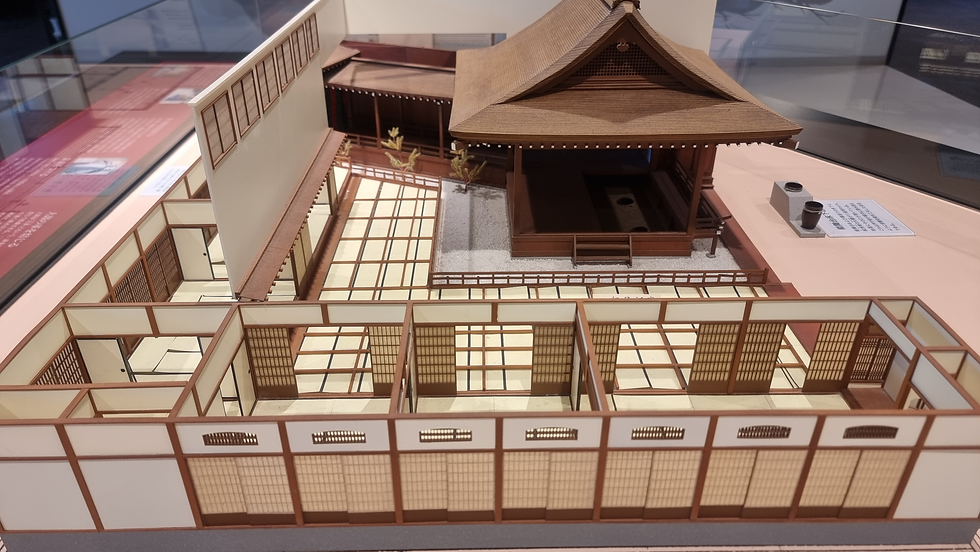
The samurai district was a little disappointing, honestly. I often find that when I'm travelling. If somewhere if a big tourist destination, it will probably turn out to be one of the less interesting places I visit. The samurai district was simply the area in which samurai used to live, full of old buildings and walls. The problem with this, however, is that as cool as that fact is, that does mean that most of the district was just the same wall over and over again. It was a nice place, with some pretty streets, but I probably went later than I should have, as the couple museums there were by this point closed. I instead enjoyed walking along the river running through it. It would take more beautiful architecture and streets than were there to beat how beautiful clean running water is to me, so I followed the river until I had to turn a corner to get back to my hotel.
My train to my next destination was the next morning, so I ate a pizza at the hotel and cosied up in my pod for the last time, ready to go straight to Toyama the next day.
Although my first impressions of Kanazawa were not very positive, and I was sure it would be the worst part of the trip, it turns out it was just my pessimism getting the better of me, and I was pleasantly surprised! Despite not having as good an experience with the locals as I had had in Fukui and Echizen, I really enjoyed my time there, and learned a lot about Japanese history and culture, so I am very grateful for that experience!
My biggest recommendations for travellers would have to be the Kaga-yuzen kimono centre and Tentokuin. Although, there are lots of places I didn't go! Kanazawa is a huge city, and a major tourist hotspot, so there were so many things do do there, you could be there for weeks and still not have done all the touristy things. I'd always advise people to search for what interests them, rather than just going to the typical "must go"s.


Comments